
 EV Chargers
 Leicestershire Solar and EV Chargers: 2026 Buyer's Guide
Leicester and Leicestershire homeowners are combining solar panels with EV chargers faster than most of the Midlands. Here is what you actually need to know.
In This Article
- 1. Solar Panels and EV Chargers in Leicestershire: The 2026 Case for Acting Now
- 2. Leicester's Net Zero 2030 Ambition and What It Means for Homeowners
- 3. System Sizing for Solar Plus EV: Getting the Numbers Right
- 4. Agile Tariffs and Smart Charging: Maximising Value from a Solar-EV System
- 5. Finding the Right Installer in Leicestershire for a Combined System
- 6. What to Expect After Installation: Support, Monitoring, and Aftercare
Solar Panels and EV Chargers in Leicestershire: The 2026 Case for Acting Now
Leicestershire has emerged as one of the more active solar and electric vehicle markets in the East Midlands, driven by a combination of Leicester City's ambitious net zero 2030 target, high rates of EV adoption across the county's commuter belt, and a housing stock that spans Victorian back-to-backs in the city centre to spacious 1960s and 1970s semis in Oadby, Wigston, and Blaby. The case for combining solar panels with an EV charger has never been more financially compelling, and specialist contractors like ElectriFusion Solutions in Doncaster have developed combined installation packages that treat the solar array and chargepoint as an integrated system rather than two separate products.
Government support for home EV chargepoints is delivered through the OZEV EV chargepoint grant, which covers 75% of the cost, up to £500 since 1 April 2026 and for renters and flat owners only, towards the cost of installing a smart home chargepoint for eligible EV or plug-in hybrid owners. The grant is available to homeowners and private tenants in properties with off-street parking, and must be claimed through an OZEV-approved installer. In Leicestershire, where semi-detached and detached housing with driveways is common in the suburban areas that account for the majority of EV registrations, grant eligibility is high and the uptake rate has grown steadily since the scheme was restructured in 2022.
Leicestershire receives approximately 1,350 hours of usable sunshine annually — somewhat below Bristol and the South West but comfortably above Scotland and Northern Ireland. For a south-facing roof installation at 35 degrees pitch, this translates to a typical generation yield of 850–950 kilowatt-hours per kilowatt-peak installed. A 4kWp domestic system in Leicester or Loughborough will generate approximately 3,400 to 3,800 kilowatt-hours per year, sufficient to cover a meaningful portion of a household's combined electricity and EV charging demand.
Leicester's Net Zero 2030 Ambition and What It Means for Homeowners
Leicester City Council adopted a net zero 2030 target that is more ambitious than the national 2050 framework, and this commitment has translated into a range of local support mechanisms, funding streams, and procurement programmes aimed at accelerating low-carbon technology adoption across the city. For homeowners in LE1 through LE5 postcodes, this means a more active local authority environment than in many comparable UK cities — one that has historically administered ECO4 and Warm Homes Local Grant funding, operated referral services to vetted installers, and used its own housing stock as a demonstrator for solar and heat pump technology at scale.
The city's focus on its housing estates — many of which consist of the brick-built semi-detached and terrace housing typical of East Midlands local authority construction from the 1950s to the 1980s — has made social housing decarbonisation a central element of the net zero programme. Leicester City Homes, the arms-length housing management organisation, has progressed significant solar installation programmes on suitable council properties, generating interest and appetite for similar upgrades among owner-occupiers in the same streets and neighbourhoods.
Loughborough University's presence in the county adds a research and innovation dimension to Leicestershire's renewable energy ecosystem. The university has active research programmes in energy storage, smart grid management, and building physics, and has produced graduates who have gone on to establish renewable energy businesses in the region. This creates a local knowledge base and talent pipeline that benefits businesses and homeowners alike — more technically informed installers, more rigorous system designs, and a local authority planning environment that tends to be supportive of renewable energy applications.
Thinking about going solar?
See exactly how much you could save
Use our free calculator to get instant savings estimates based on your bill and home size.
System Sizing for Solar Plus EV: Getting the Numbers Right
Sizing a combined solar and EV charger system correctly requires a more detailed analysis than sizing solar for electricity consumption alone. An electric vehicle adds a significant and concentrated load — a typical home charger operating at 7kW will consume 7 kilowatt-hours per hour of charging, meaning that a vehicle charged for four hours overnight draws as much electricity as an average household uses in two days. Getting this right from the outset means the difference between a system that significantly reduces grid imports and one that leaves substantial charging demand unmet by solar generation.
The optimal approach for Leicestershire homeowners is to model their annual EV mileage, convert to kilowatt-hours consumed, and add this to their household electricity consumption before sizing the solar array. A household using 3,500 kilowatt-hours of electricity annually and driving 8,000 miles per year in an EV consuming 3.5 miles per kilowatt-hour will have a total annual demand of approximately 5,800 kilowatt-hours. Serving this demand with solar at Leicestershire's irradiance levels would require an array of approximately 6kWp — larger than the 3–4kWp that many domestic installers default to quoting. Specialists such as Lumos Energy in Wiltshire apply this kind of demand-led sizing methodology as standard, ensuring customers receive a system specification grounded in their actual usage rather than in roof space availability or budget convenience.
Smart EV chargers that integrate with solar inverters — directing surplus solar generation to the car rather than exporting it to the grid — are now widely available from multiple manufacturers and are strongly recommended for any combined solar-EV installation. These systems use APIs to communicate between the inverter and charger, automatically adjusting charging rate to match available solar surplus. The result is that a significant proportion of the vehicle's annual charging can be met from the roof at zero marginal cost, improving the financial return on both the solar array and the chargepoint.
Agile Tariffs and Smart Charging: Maximising Value from a Solar-EV System
The intersection of solar generation, battery storage, and smart EV charging has created a new category of energy management for Leicestershire households in 2026. Time-of-use electricity tariffs — including Octopus Agile, Intelligent Octopus, and equivalent products from other suppliers — allow households to shift their grid import to periods when wholesale electricity prices are lowest, sometimes to near-zero or even negative prices during periods of high renewable generation on the national grid. For EV owners with a solar array, this creates a three-layer optimisation opportunity: self-consume solar during the day, charge the battery or car from cheap grid electricity overnight, and export surplus solar at export tariff rates during peak demand periods.
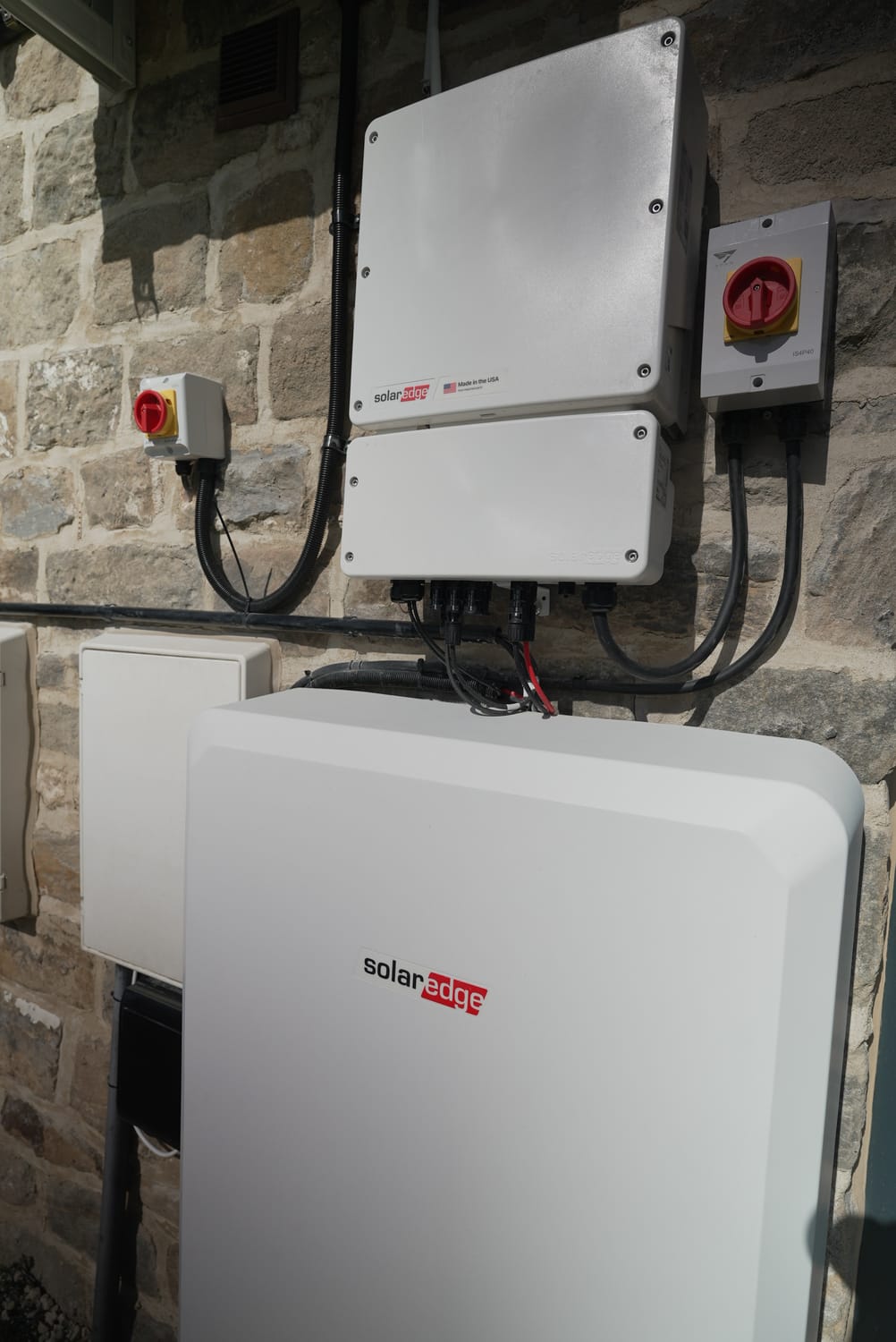
Realising this optimisation potential requires compatible hardware throughout the system — an inverter with smart export and import management, a battery system capable of charge scheduling, an EV charger with load management and solar integration, and ideally a smart home energy management system that coordinates all three. The complexity of getting this right is one of the main reasons specialist integrated system design has become a differentiator in the Leicestershire market. A household that simply buys the cheapest inverter, battery, and chargepoint separately may find they are incompatible or require expensive add-on hardware to communicate.
Victorian terraced housing in Leicester's inner suburbs — areas like Highfields, Stoneygate, and parts of Aylestone — presents particular challenges for solar-EV systems. Many terraces have front-of-house parking on the street rather than a private driveway, making OZEV-eligible home chargepoint installation impossible without the relevant permits. Solar on these properties may also be constrained by terraced roof configurations and orientation. For these households, a battery system without solar — charged on an overnight cheap-rate tariff — may deliver better economics than attempting a solar installation on an unsuitable roof.
Finding the Right Installer in Leicestershire for a Combined System
A combined solar and EV charger installation requires a contractor who holds both MCS solar certification and OZEV chargepoint installer registration — these are separate schemes with separate competence requirements, and not all solar installers are OZEV-registered, and not all OZEV-registered chargepoint installers are MCS-certified for solar. Leicestershire homeowners should verify both credentials before appointing a contractor for a combined system. Solar Bureau's national network includes installers vetted across multiple technology categories, making it a useful starting point for finding contractors who hold the complete set of relevant accreditations for a solar-EV project.
Getting multiple quotes remains important even when an installer comes with strong credentials and positive reviews. In Leicestershire's competitive installer market, quotes for a combined 4kWp solar, 10kWh battery, and 7kW EV charger system in 2026 can vary by £2,000 to £4,000 for equivalent specification, reflecting differences in margin, component selection, and installation approach. The cheapest quote is not always the worst — but any quote that is significantly below market rate should be examined carefully to understand where the saving is being made, as it is often in component quality or installation scope rather than genuine efficiency.
Selecting an MCS-certified installer provides assurance that the system design, installation practices, and handover documentation meet the standards required to access Smart Export Guarantee tariffs and to maintain manufacturer warranties. For the EV charger element, OZEV registration ensures grant eligibility and confirms that the installation will meet the smart charging requirements mandated by the Smart Charge Points Regulations 2021 — a legal requirement for all new home chargepoints, not just those claiming the grant.
What to Expect After Installation: Support, Monitoring, and Aftercare
A well-specified solar-EV system in Leicestershire should come with a monitoring platform that allows the homeowner to track generation, consumption, battery state of charge, and EV charging sessions from a smartphone app. Most modern inverter manufacturers provide cloud-based monitoring as standard, and EV charger manufacturers similarly provide app-based session monitoring. Installers who configure and demonstrate these monitoring tools at handover give their customers the visibility needed to optimise system performance and to identify any underperformance issues before they become significant.
Teesside's ALPS Electrical has built a strong reputation for post-installation customer support — a quality that is particularly valued in the solar-EV market where the interaction between multiple systems can occasionally require remote or on-site troubleshooting. Leicestershire homeowners should ask any prospective installer what their response time commitment is for post-installation support issues, and whether their aftercare service is delivered by their own team or via third-party call centres. Direct access to the installing technician for the first twelve months is a reasonable expectation and one that quality installers should be willing to commit to.
Hampshire's Solent Solar represents the kind of specialist regional operation that demonstrates how high standards of technical installation and aftercare can be delivered sustainably in a competitive market — a model that the best Leicestershire installers aspire to and that discerning customers should use as a quality benchmark when making their selection. In a market where the investment is substantial and the technology lifespan is measured in decades, choosing an installer who will still be operating and contactable when a service issue arises five or ten years hence is as important as the headline installation price.
Get Expert Advice from ElectriFusion Solutions
At ElectriFusion Solutions, we are MCS-certified, NAPIT-registered, and TrustMark-endorsed specialists in solar panel installation, battery storage, and EV charger installation across South Yorkshire and Northern England. Our team has completed over 1,000+ installations and maintains a 4.7/5 rating on Trustpilot from 45 reviews.
Whether you are considering solar panels for the first time or looking to add battery storage to an existing system, we offer free, no-obligation site surveys with transparent pricing and no pushy sales tactics. Every installation comes with our industry-leading warranty package, including 15 years workmanship, up to 15-year inverter, and up to 15-year battery warranties.
Contact our team today on 01302 203 755 or request a free survey online. We cover Doncaster, Sheffield, Rotherham, Barnsley, and the wider South Yorkshire region.