
 Solar Education
 Air Source Heat Pumps in Cornwall and Devon: 2026 Installation Guide
Cornwall and Devon have the mildest winters and some of the highest sunshine in the UK — making them ideal territory for air source heat pumps. The complete 2026 guide.
In This Article
- 1. Why Cornwall and Devon Are Perfect for Air Source Heat Pumps in 2026
- 2. Off-Gas-Grid Properties: The Ideal Candidates for Heat Pumps in the South West
- 3. Installation Logistics and What the Process Looks Like
- 4. Planning in AONBs and How Conservation Rules Affect Heat Pump Installations
- 5. Combining Solar Panels with a Heat Pump in Cornwall and Devon
- 6. Aftercare, Servicing, and Long-Term Performance in Cornwall
Why Cornwall and Devon Are Perfect for Air Source Heat Pumps in 2026
Cornwall and Devon enjoy the mildest winters of any English region, a climatic advantage that translates directly into better air source heat pump performance. The Atlantic influence on South West weather means that even in January and February, outdoor temperatures in coastal Cornwall rarely fall below two or three degrees Celsius for extended periods — conditions under which a modern heat pump can maintain a coefficient of performance above 2.5, delivering two and a half units of heat for every unit of electricity consumed. By contrast, heat pumps operating in Yorkshire or the East Midlands during cold snaps face sustained temperatures of minus five to minus ten, where performance drops significantly and supplementary electric heating may be needed. Cornwall and Devon's mild winter baseline makes the financial and operational case for ASHP unusually strong. Specialists such as Leicester installer Energy Concerns have published comparative performance data that underlines how Southern and South Western regions consistently outperform national average COP figures, which is a critical factor in making the running cost calculations credible.
The financial case is further strengthened by the Boiler Upgrade Scheme, which provides a £7,500 grant towards air source heat pump installation for eligible English households. For a Cornwall property where installation costs typically run between £8,000 and £14,000 including the outdoor unit, refrigerant pipework, internal distribution modifications, and hot water cylinder, the BUS grant reduces the net investment to between £500 and £6,500 depending on system complexity. At the lower end of that range, a well-insulated Devon bungalow replacing an oil boiler can achieve a positive return on the net investment within three to four years based on current oil and electricity price differentials.
The combination of mild climate, high proportion of off-gas-grid rural properties, and available BUS funding makes Cornwall and Devon arguably the strongest case for ASHP adoption of any English region in 2026. Homeowners and landlords who have been considering the switch from oil or LPG but hesitating on cost grounds should revisit the numbers with current BUS grants and current energy prices before making a decision to defer further.
Off-Gas-Grid Properties: The Ideal Candidates for Heat Pumps in the South West
Approximately thirty percent of properties in Cornwall and a significant proportion in rural Devon are not connected to the mains gas network, relying instead on oil, LPG, or solid fuel for space heating. These households face energy costs that are structurally higher than gas-connected counterparts and more volatile, exposed to global oil and gas commodity prices without the buffering effect of pipeline infrastructure. For these properties, the case for switching to an air source heat pump is not primarily about reducing carbon emissions — though that benefit is real — it is about energy cost stability and independence from fossil fuel supply chains.
Heating oil prices in Cornwall in 2025 and early 2026 have ranged between 65p and 80p per litre, placing annual heating costs for a three-bedroom rural cottage using 2,000 litres per year between £1,300 and £1,600. A correctly sized and installed ASHP in the same property, operating at a seasonal COP of 2.8 to 3.2 on a standard electricity tariff, would typically cost between £700 and £1,000 per year to run — a saving of £300 to £900 annually depending on tariff and usage patterns. On an Economy 7 or Agile tariff optimised for overnight charging, running costs can be reduced further.
The fabric-first principle applies with particular force in rural Cornwall and Devon, where a significant proportion of the housing stock is constructed from traditional cob, stone, or cob-and-stone hybrid construction methods. These materials have thermal characteristics different from modern cavity wall construction, and heat loss calculations must account for their specific properties rather than applying standard U-value tables. Homeowners considering ASHP for an older stone cottage should commission a proper heat loss survey from a qualified engineer before proceeding — and should expect that some level of insulation improvement may be recommended before the heat pump is installed.
Thinking about going solar?
See exactly how much you could save
Use our free calculator to get instant savings estimates based on your bill and home size.
Installation Logistics and What the Process Looks Like
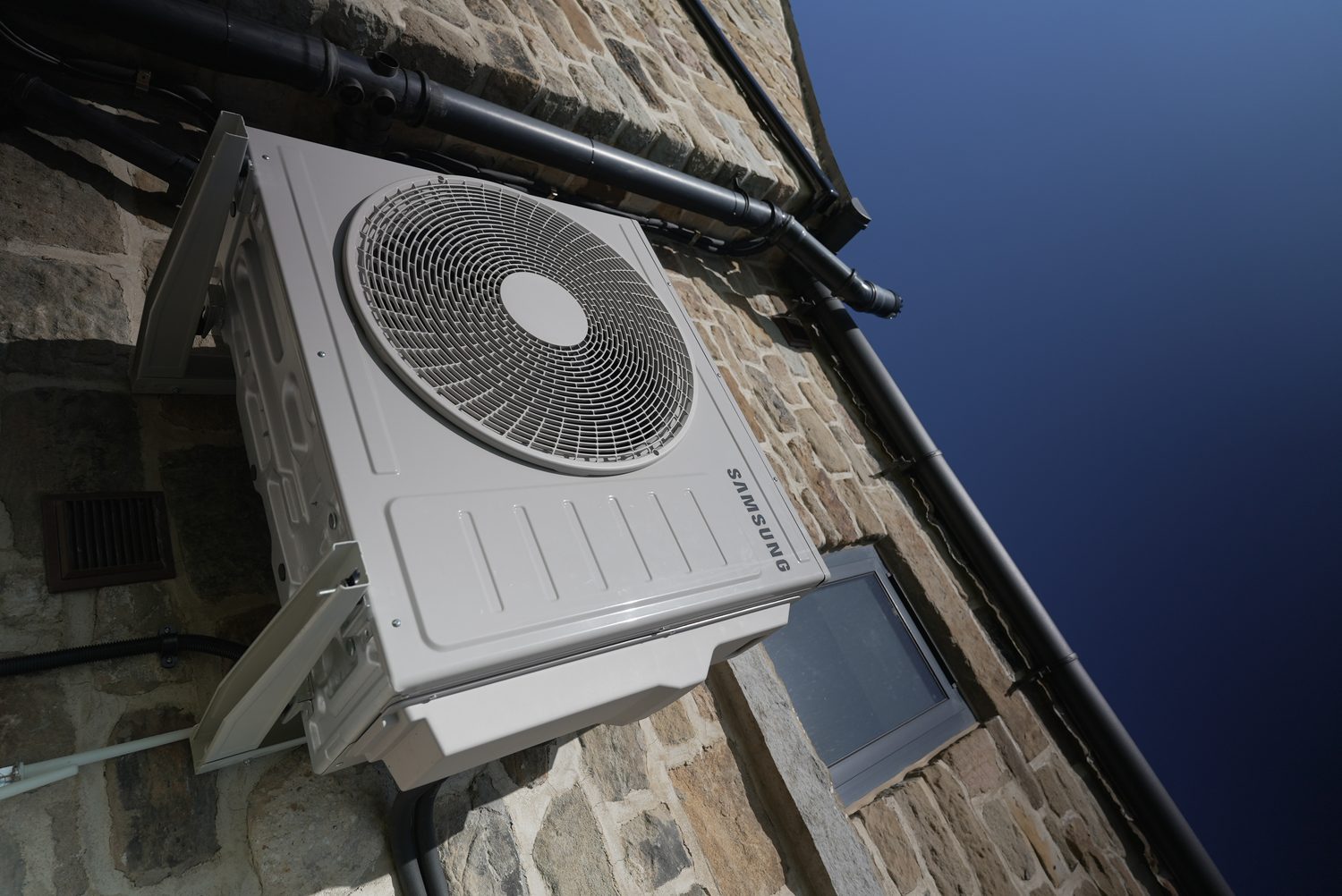
A standard air source heat pump installation in a South West property takes between two and four days depending on the complexity of the existing heating distribution and the extent of any cylinder or pipework modifications required. The outdoor unit is typically mounted on a ground slab or wall bracket in a location with good air circulation, away from boundaries and bedrooms to minimise noise impact. In rural Cornwall, space is rarely a constraint, but in terraced or semi-detached properties in towns like Truro, Bodmin, or Barnstaple, the siting of the outdoor unit requires more careful consideration.
Internally, most ASHP installations require a larger hot water cylinder than the one supplied with a conventional combi boiler, because heat pumps are most efficient when heating water to 45–55 degrees Celsius rather than the higher temperatures used in conventional boiler systems. This means assessing cylinder location and available space early in the project. Many South West properties that previously used an oil system will have an existing unvented or vented cylinder that can be upgraded rather than replaced, reducing both cost and installation time. Companies such as AMP Pro Electrical in Doncaster routinely assist clients in understanding the electrical scope of heat pump projects, ensuring that the supply capacity and protective arrangements are correctly assessed alongside the heating system design.
Radiator sizing is the most commonly misunderstood element of ASHP installations. Because heat pumps deliver water at lower temperatures than gas boilers, existing radiators may be undersized for the heat output required. A proper MCS system design will calculate the heat output needed from each radiator circuit at the design flow temperature and identify which radiators need to be upsized. Skipping this step — fitting a heat pump without upgrading undersized radiators — is the most common cause of underperforming ASHP installations, and it is entirely avoidable with a proper pre-installation survey.
Planning in AONBs and How Conservation Rules Affect Heat Pump Installations
A significant proportion of Cornwall and Devon falls within Areas of Outstanding Natural Beauty — the Cornwall AONB covers large parts of the county, and Dartmoor and Exmoor National Parks cover substantial areas of Devon. Within these designations, and in the various conservation areas that protect the character of towns including St Ives, Padstow, Totnes, and Dartmouth, permitted development rights for external heat pump installations may be modified or removed.
The Boiler Upgrade Scheme does not require planning permission as a condition of the grant, but the physical installation of the outdoor unit may itself require consent in restricted areas. Homeowners in designated areas should check with their local planning authority before installation begins — a standard permitted development check from the local authority or via the Planning Portal is the most reliable way to confirm whether consent is needed. In National Parks, the relevant planning authority is the National Park Authority rather than the county or district council.
For properties within conservation areas in Truro, Falmouth, or Exeter, the key question is whether the outdoor unit will be installed on a wall or surface that faces a highway. If so, prior approval may be required under Class G permitted development rules, and the application must demonstrate that the installation will have the least visual impact reasonably practicable. Experienced South West installers who regularly work in conservation areas and AONB locations will be familiar with this process and can manage the application on the homeowner's behalf.
Combining Solar Panels with a Heat Pump in Cornwall and Devon
The combination of solar PV and an air source heat pump is increasingly regarded as the optimal low-carbon package for off-grid rural South West properties. The solar array reduces the effective running cost of the heat pump by supplying free electricity during spring, summer, and autumn, when both generation and heating overlap in the shoulder seasons. In winter, when solar generation is lower and heating demand is highest, the heat pump runs primarily on grid electricity — but at a COP of 2.5 to 3.0, even grid electricity delivers heat more cheaply than oil or LPG.
Hull-based Snug Services has published case study analysis showing that the combined solar-ASHP system can reduce total energy bills in comparable off-grid rural properties by fifty to sixty percent compared to an oil boiler without solar. For Cornwall and Devon homeowners facing the dual challenge of high oil costs and high electricity tariffs, this dual-technology approach addresses both sides of the energy budget simultaneously. The key design consideration is ensuring the solar array is sized with the heat pump's annual consumption in mind, not just the household's existing electricity usage.
Working with an MCS-certified heat pump installer is non-negotiable for Boiler Upgrade Scheme eligibility and is strongly recommended on quality grounds regardless of grant status. MCS certification for heat pump installation covers system design methodology, refrigerant handling, commissioning, and handover documentation. It ensures that the installer has demonstrated competence against national standards and that the system design has been carried out according to the required heat loss calculation methodology rather than estimated from room count or floor area alone.
Aftercare, Servicing, and Long-Term Performance in Cornwall
Air source heat pumps are robust systems with a typical design life of fifteen to twenty years, but they require annual servicing to maintain performance and preserve manufacturer warranties. In Cornwall and Devon, the servicing market for ASHP is developing rapidly but is not yet as mature as the gas boiler service industry, meaning that homeowners should confirm a service agreement is in place before the installation warranty period expires. The servicing scope typically includes cleaning the outdoor unit heat exchanger, checking refrigerant pressure, verifying flow temperatures, and updating controls firmware where applicable.
Solar Maintenance Solutions exemplifies the kind of specialist O&M provider that the renewables sector needs more of — a company focused specifically on the servicing and maintenance of installed low-carbon systems rather than installation alone. As the South West's ASHP installed base grows, the demand for qualified service engineers with refrigerant handling certification (F-Gas) will grow proportionally, creating a long-term career path for the region's heating and electrical trades.
Teesside's ALPS Electrical illustrates how companies with roots in conventional electrical contracting have successfully incorporated renewable energy servicing into their operational model — a transition that many South West electrical and heating contractors are beginning to make. For Cornwall and Devon homeowners choosing an ASHP installer in 2026, asking about the company's servicing capability and confirming that an annual maintenance contract is available before committing to the installation is a straightforward way to protect the long-term performance of a significant investment.
Get Expert Advice from ElectriFusion Solutions
At ElectriFusion Solutions, we are MCS-certified, NAPIT-registered, and TrustMark-endorsed specialists in solar panel installation, battery storage, and EV charger installation across South Yorkshire and Northern England. Our team has completed over 1,000+ installations and maintains a 4.7/5 rating on Trustpilot from 45 reviews.
Whether you are considering solar panels for the first time or looking to add battery storage to an existing system, we offer free, no-obligation site surveys with transparent pricing and no pushy sales tactics. Every installation comes with our industry-leading warranty package, including 15 years workmanship, up to 15-year inverter, and up to 15-year battery warranties.
Contact our team today on 01302 203 755 or request a free survey online. We cover Doncaster, Sheffield, Rotherham, Barnsley, and the wider South Yorkshire region.