
 Battery Storage
 The Complete Guide to Home Battery Storage in the UK for 2026
The complete guide to home battery storage in the UK — Tesla, Sigenergy, Fox ESS, Hanchu compared, with real cost and savings data for 2026.
In This Article
- 1. How Home Battery Storage Works
- 2. Which Battery System Should You Choose?
- 3. Battery Storage Costs and Return on Investment
How Home Battery Storage Works
A home battery storage system captures surplus electricity — either from your solar panels or from the grid during cheap overnight periods — and holds it for later use. The most common installation pattern pairs battery storage with solar panels: your panels generate electricity throughout the day, any excess beyond your immediate household consumption charges the battery, and in the evening when your panels stop generating, the battery discharges to power your home instead of drawing from the grid at expensive peak-period prices. This cycle can increase your solar self-consumption rate from the typical 40–50% achieved without a battery to 80–90%.
Modern battery storage systems use lithium-ion chemistry in various configurations. The dominant technologies in the 2026 UK market are lithium iron phosphate (LFP) — used in the Tesla Powerwall 3, Sigenergy, and Fox ESS EVO — and lithium nickel manganese cobalt oxide (NMC) — used in some Hanchu systems. LFP chemistry has become the preferred choice for home storage because of its superior cycle life (3,000–6,000 full charge-discharge cycles versus 1,500–2,000 for older NMC chemistries), inherently greater thermal stability, and longer calendar life. The leading LFP batteries in the UK market carry 10–15 year performance warranties, and ElectriFusion Solutions backs the batteries it installs with an up to 15-year replacement warranty.
Battery storage works with all grid-connected solar systems, but the integration method varies. DC-coupled systems — where the battery connects between the solar panels and the inverter — are the most efficient architecture, as solar energy flows directly into the battery without the DC-to-AC-to-DC conversion losses of AC-coupled systems. Hybrid inverters (which handle both solar and battery in a single unit) use DC coupling and are now the dominant architecture for new combined solar-and-battery installations. AC-coupled batteries — such as the Tesla Powerwall 3 in its standard configuration — are simpler to retrofit onto existing solar systems and connect to the AC side of the house, but incur a small efficiency penalty compared to DC-coupled systems.
Which Battery System Should You Choose?
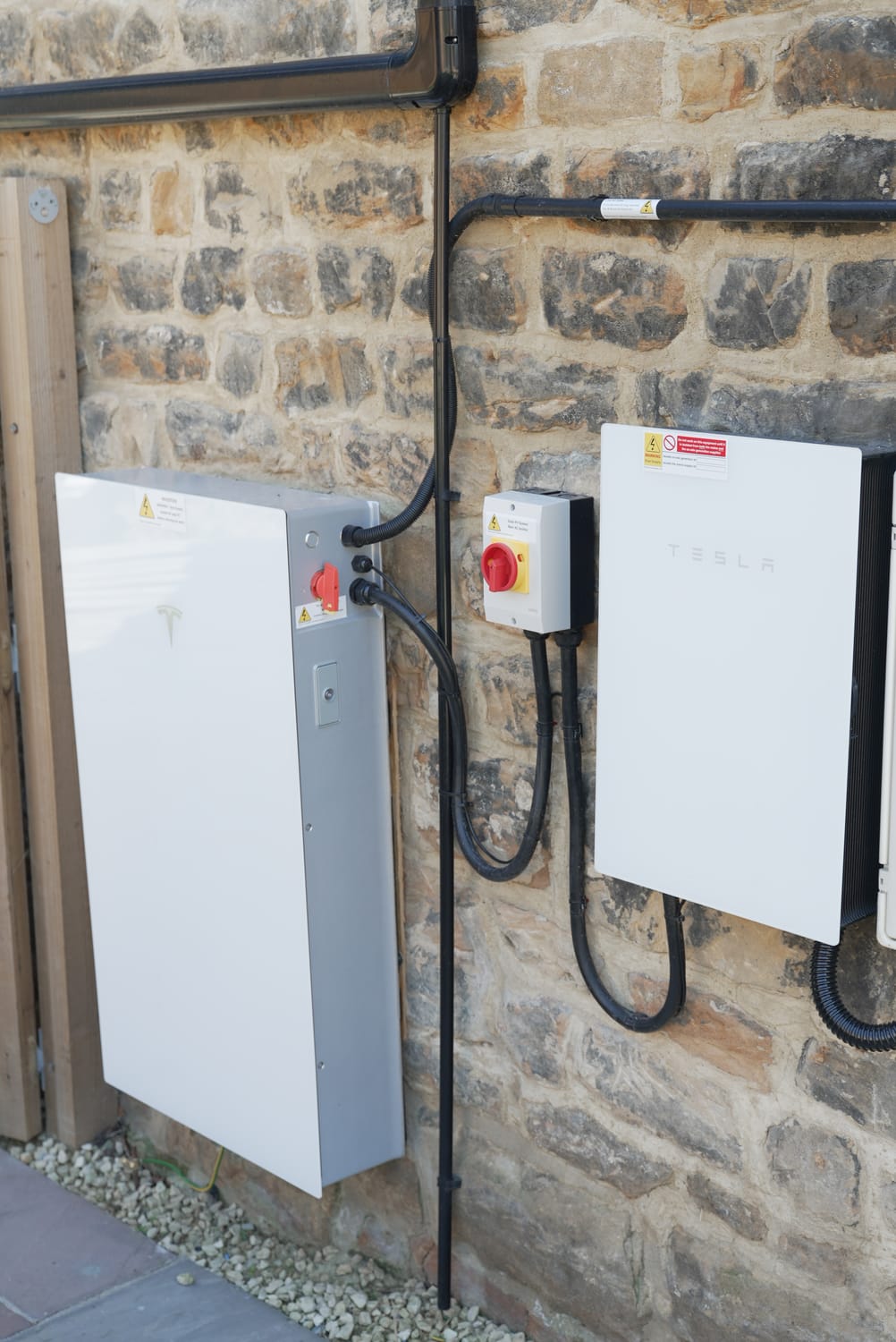
The UK market in 2026 offers several excellent battery storage options, each suited to different needs. The Tesla Powerwall 3 is the most well-rounded choice for most UK homes: at 13.5kWh capacity with an integrated inverter, it handles both solar management and battery storage in a single unit, offers excellent monitoring through the Tesla app, and is supported by Tesla's UK service network. It is the best choice for households who want simplicity, a proven product with wide installer familiarity, and the assurance of a major manufacturer's service infrastructure. View Tesla Powerwall 3 specifications.
The Sigenergy SigenStor is the best choice for households planning to expand storage capacity over time or who have or plan to install a vehicle-to-home (V2H) capable EV charger. Its modular architecture starts at 5kWh and expands in 5kWh increments without additional inverter purchase, and its built-in V2H capability allows bidirectional charging with compatible EVs. The Fox ESS EVO is the best-looking system in the market — its ultra-slim profile and interchangeable magnetic front panels make it the choice for design-conscious homeowners, and its IP65 outdoor rating means it can be installed in locations where other systems cannot. The Hanchu Hybrid system handles high power loads and off-grid operation that none of the other systems in this range can match. Compare all battery storage systems we install.
Battery capacity sizing should match both your solar system size and your household consumption pattern. A rough guide: for a 3.9–4.85kWp solar system on a 3-bedroom home, a 5–7kWh battery captures most of the daily surplus without over-investing in storage capacity that rarely fills. For a 5–6kWp system on a larger home with an EV, 10–13.5kWh is the appropriate range. For households on Agile tariffs who also want to charge from cheap off-peak grid electricity overnight, a larger 13.5–20kWh system maximises the arbitrage opportunity. Read our full battery sizing guide.
Thinking about going solar?
See exactly how much you could save
Use our free calculator to get instant savings estimates based on your bill and home size.
Battery Storage Costs and Return on Investment
Battery storage installation costs in the UK in 2026 range from £2,500–£4,000 for a 5kWh system to £5,000–£7,500 for a 10kWh system. The Tesla Powerwall 3 at 13.5kWh is typically quoted at £8,000–£10,500 installed by a certified installer, while Sigenergy and Fox ESS EVO systems fall in the £5,500–£8,000 range for 10kWh capacity. These prices assume installation alongside solar panels — standalone battery retrofits to existing solar systems are typically 20–30% more expensive per kWh of capacity due to additional configuration work and the absence of shared scaffold hire.
Return on investment for battery storage depends on your use case. For a household with 4.85kWp solar panels adding a 10kWh battery, the increase in self-consumption savings is approximately £360–£480 per year — implying a payback period for the battery of 12–18 years in isolation. However, when the battery is viewed as part of the whole solar-plus-battery system rather than a standalone investment, the combined payback period is only marginally longer than solar alone (typically 9–13 years versus 7–11 years), and the total financial return over 25 years is substantially higher. Read our in-depth analysis of whether battery storage is worth it.
Time-of-use tariff arbitrage offers an additional revenue stream for battery owners regardless of whether they have solar panels. Batteries charged overnight on Octopus Agile or Intelligent Octopus at off-peak rates of 5–8p/kWh and discharged during evening peak periods at 28–35p/kWh can generate £300–£500 per year in savings for a well-managed 10kWh system. The best battery management systems — including Tesla's Powerwall software and Sigenergy's platform — handle this tariff optimisation automatically, identifying the cheapest charging windows without manual intervention.
Get Expert Advice from ElectriFusion Solutions
At ElectriFusion Solutions, we are MCS-certified, NAPIT-registered, and TrustMark-endorsed specialists in solar panel installation, battery storage, and EV charger installation across South Yorkshire and Northern England. Our team has completed over 1,000+ installations and maintains a 4.7/5 rating on Trustpilot from 45 reviews.
Whether you are considering solar panels for the first time or looking to add battery storage to an existing system, we offer free, no-obligation site surveys with transparent pricing and no pushy sales tactics. Every installation comes with our industry-leading warranty package, including 15 years workmanship, up to 15-year inverter, and up to 15-year battery warranties.
Contact our team today on 01302 203 755 or request a free survey online. We cover Doncaster, Sheffield, Rotherham, Barnsley, and the wider South Yorkshire region.