
 Local Guides
 Bristol and the South West: Solar Installs That Actually Work in 2026
A Bristol installer's breakdown of what's working for South West homeowners in 2026 — solar, batteries, heat pumps, and the local market explained.
In This Article
- 1. Why Bristol and the South West Are Ideal for Solar in 2026
- 2. Conservation Areas, Planning Permission, and Bristol's Victorian Housing Stock
- 3. Battery Storage Adoption in the South West: Higher Than the National Average
- 4. Commercial Solar in South West Water and the Business Sector
- 5. Heat Pump and Solar Combinations in Rural Somerset and Devon
- 6. How to Select a Solar Installer in Bristol and the South West
Why Bristol and the South West Are Ideal for Solar in 2026
Bristol and the broader South West region have quietly established themselves as some of the most solar-productive areas in England, and the numbers in 2026 make a compelling case for homeowners and businesses who have not yet acted. The region receives approximately 1,600 hours of usable sunshine annually — meaningfully more than the UK average and sufficient to make even a modestly sized rooftop array financially productive. Installers working across the region consistently report that South West clients see generation figures closer to the high end of manufacturer estimates, particularly in coastal areas of Somerset and Devon where Atlantic weather patterns bring long bright spells between rainfall episodes. Teams like Premier Electrical Renewables in Yorkshire have noted that their own northern clients generate roughly fifteen percent less annually than equivalent South West systems — a gap that compounds significantly over the lifetime of an installation.
The Energy Saving Trust advice on solar panels consistently emphasises that location is one of the primary determinants of system performance alongside roof orientation and pitch. For Bristol homeowners, a south-facing roof at 30–40 degrees of pitch will typically generate 900–1,100 kilowatt-hours per kilowatt-peak installed annually — figures that support a payback period of seven to ten years for a self-funded system with no battery, or six to eight years when a smart export tariff is included in the model.
The South West's solar credentials extend beyond domestic rooftops. Commercial and agricultural sectors have been early adopters of large-scale roof-mounted generation, with farm buildings across Somerset, Wiltshire, and Dorset hosting arrays that reduce energy costs for irrigation, refrigeration, and processing equipment. The combination of available roof space, high sunshine hours, and agricultural energy intensity has made South West commercial solar economics unusually favourable compared to national benchmarks.
Conservation Areas, Planning Permission, and Bristol's Victorian Housing Stock
Bristol's architectural character is both a visual asset and a practical complication for solar installation. The city contains several designated conservation areas — Clifton, Redland, Cotham, and Montpelier among the most extensive — where permitted development rights for solar panels are more restricted than in standard residential areas. Within these zones, panel installations on roof slopes visible from public highways typically require prior approval or full planning permission, and the design must be assessed against the presumption in favour of preserving the character and appearance of the area.
In practice, this means Bristol homeowners in conservation areas should begin any solar project with a call to Bristol City Council's planning department to confirm the applicable rules for their specific street and property type. Many conservation area installations do proceed successfully, particularly on rear roof slopes not visible from the street, and planning officers in Bristol have generally adopted a pragmatic approach to solar given the city's ambitious net zero commitments. Submitting a clear application with photographs, panel specifications, and a heritage impact assessment prepared by an experienced installer significantly improves the likelihood of approval.
The Victorian and Edwardian terraces that dominate Redland, Bishopston, and Bedminster present structural considerations beyond planning. These properties typically have older timber roof structures that require a load assessment before modern panel systems are fitted. Reputable South West installers will include a structural survey in their quoted scope, checking rafter sizing, ridge condition, and overall roof integrity before proceeding. Skipping this step to reduce costs is a false economy — remedial structural work on a loaded roof is far more expensive than preventive assessment.
Thinking about going solar?
See exactly how much you could save
Use our free calculator to get instant savings estimates based on your bill and home size.
Battery Storage Adoption in the South West: Higher Than the National Average
The South West has one of the highest rates of battery storage adoption alongside solar panels in England, and the trend has accelerated through 2025 and into 2026 as battery costs have fallen and grid export rates have remained relatively low. For homeowners who work from home, run electric vehicles, or have heat pumps, a battery system transforms the value of a solar installation by shifting generated power from midday peaks into evening and morning demand periods when grid electricity would otherwise need to be imported. The economics are particularly strong for households on time-of-use tariffs, where overnight cheap-rate charging can further reduce bills.
Installers across Bristol, Bath, and the wider Somerset corridor report that the majority of new domestic solar installations they complete in 2026 include battery storage as standard. System sizes typically range from 5kWh to 15kWh of usable capacity, with 10kWh emerging as the most popular choice for a three-to-four bedroom household with an electric vehicle. Specialist companies like Leicester installer Energy Concerns have documented how the right battery sizing approach — based on half-hourly consumption analysis rather than rule-of-thumb estimates — can improve system economics by fifteen to twenty percent compared to undersized or oversized installations.
Grid services participation is an emerging revenue stream for South West battery owners in 2026. Virtual power plant aggregation schemes allow households to offer their battery capacity to grid balancing services, earning additional payments for flexibility. Several platforms are operating in the UK market, and forward-thinking installers are now specifying battery hardware that is pre-approved for these schemes, allowing clients to participate without a hardware upgrade when they are ready to do so.
Commercial Solar in South West Water and the Business Sector
Commercial solar deployment across the South West accelerated significantly in 2024 and 2025, driven by energy cost pressure on businesses and the availability of Enhanced Capital Allowances for qualifying investments. Water industry operators including South West Water and Wessex Water have both progressed significant behind-the-meter solar programmes at their treatment works, pumping stations, and operational depots — facilities that consume substantial amounts of electricity during daylight hours and often have large south-facing roof areas or available ground space.
For smaller commercial operators — hospitality businesses, food producers, light manufacturers, and logistics companies — the South West's commercial solar market in 2026 is characterised by strong installer competition and increasingly sophisticated financial modelling. Power Purchase Agreement structures have become more common as a route to zero-capex solar, with terms that reflect the South West's above-average generation profile. A PPA rate negotiated on the basis of Bristol or Exeter irradiance data will typically be more attractive than a national average rate, because the developer's revenue projections are supported by higher expected generation.
Rural South West businesses face different considerations, particularly around grid connection capacity. Many farms and rural enterprises in Devon, Cornwall, and West Somerset are served by distribution circuits with limited export headroom, requiring either a constraint management arrangement with the local DNO or a configuration that prioritises self-consumption over export. An experienced commercial installer will conduct a grid connection assessment as a standard part of feasibility, before any financial modelling is presented to the client.
Heat Pump and Solar Combinations in Rural Somerset and Devon
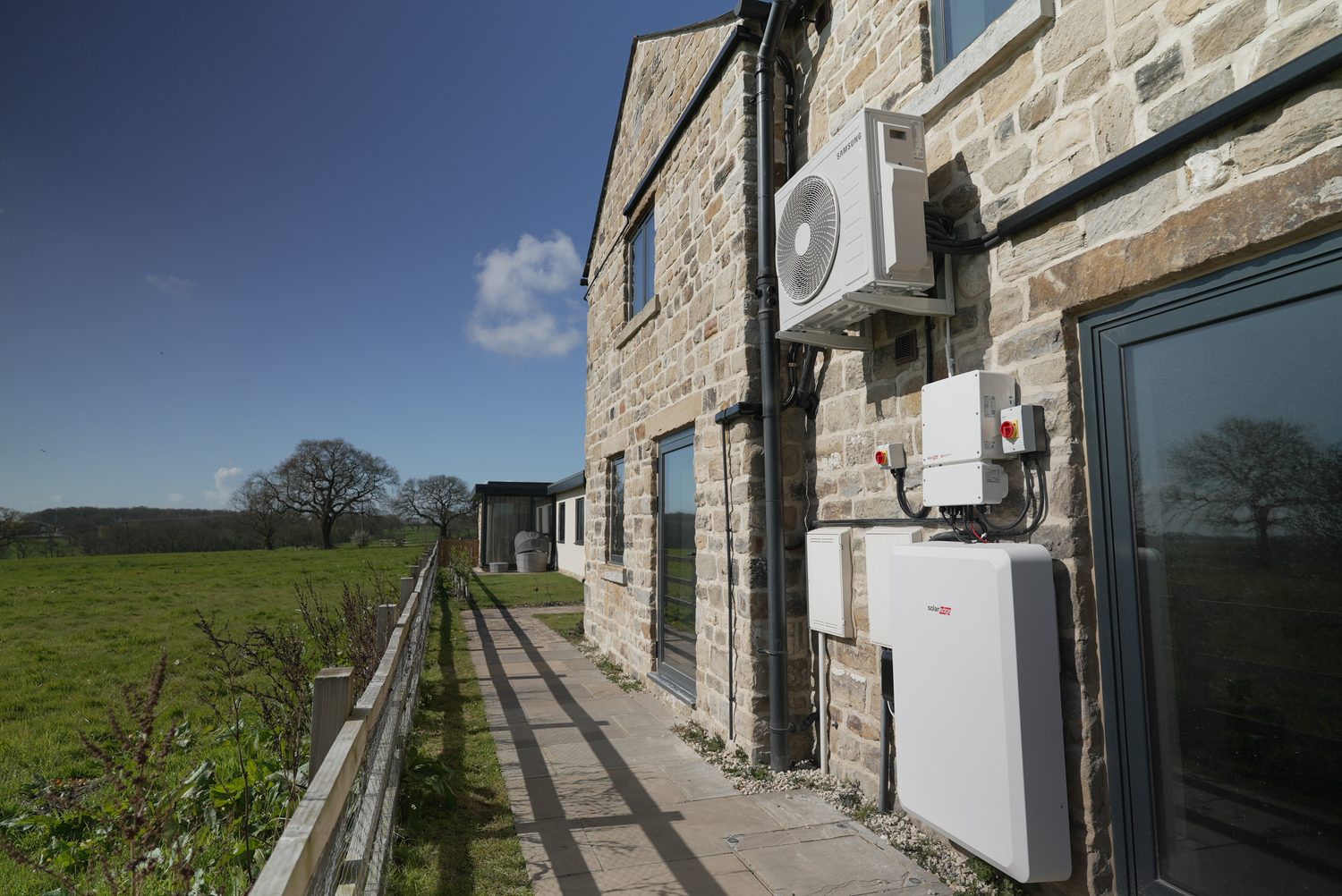
Rural Somerset and Devon represent some of the strongest conditions in England for solar and heat pump combination installations. The logic is compelling: properties off the gas grid that rely on oil or LPG for heating face fuel costs far higher than gas-connected urban households, and the switch to an air source heat pump dramatically reduces both running costs and carbon emissions. Paired with a solar array, the heat pump's electricity consumption during spring and autumn — when both generation and heating demand overlap — can largely be met from the roof, with battery storage bridging the gap into the evening heating period.
AMP Pro Electrical in Doncaster has contributed to the national evidence base showing how integrated system design — where the solar array is sized with the heat pump's consumption profile in mind rather than independently — can improve whole-system economics by a meaningful margin. For a three-bedroom rural Devon property replacing oil central heating with an ASHP and adding a 4kWp solar array with 10kWh storage, the combined annual saving on energy bills can reach £2,000 to £2,800 depending on oil price benchmarks and grid tariff structure.
Choosing a certified installer is central to the quality assurance of any combined solar and heat pump project. MCS certification is required for heat pump installations under the Boiler Upgrade Scheme and for solar installations under the Smart Export Guarantee, making it both a grant requirement and a mark of technical competence. South West homeowners should verify MCS status for both technologies before appointing a contractor — and should ask whether the same company holds certification for both disciplines or whether separate sub-contractors are involved for different elements.
How to Select a Solar Installer in Bristol and the South West
The Bristol and South West solar market in 2026 contains a healthy mix of established regional installers, national companies with local teams, and newer entrants attracted by strong demand. For homeowners, the key differentiators to assess are: MCS certification status and the specific technologies covered; years of operation in the South West specifically; the quality and specificity of the financial modelling they provide; whether they carry out their own installations or sub-contract; and their approach to aftercare and warranty support. Snug Services Group in Hull demonstrates the standard of operational maturity that clients should look for — an established business with verifiable track record, clear accreditation, and a structured approach to post-installation support.
For homeowners who want to compare multiple certified installers efficiently, referral and comparison platforms can provide a useful starting point. Solar Bureau's national network connects homeowners with vetted regional installers, making it easier to receive multiple comparable quotes without the time investment of independent research into each company's credentials. Using a comparison service does not remove the need for independent verification — checking MCS status, Companies House records, and direct references remains important — but it can surface installers that might not appear prominently in organic search results.
Timing considerations in 2026 favour moving sooner rather than later. Installer capacity across the South West is currently more available than in 2023 and 2024, when a surge in demand following energy price spikes created long lead times. The combination of improved availability, continued panel price reductions, and a policy environment that still supports solar through zero-percent VAT and the Smart Export Guarantee makes 2026 a strong year to proceed. Homeowners who have been considering solar for several years and waiting for the "right moment" will find that the current combination of economics and availability is among the most favourable since the market's inception.
Get Expert Advice from ElectriFusion Solutions
At ElectriFusion Solutions, we are MCS-certified, NAPIT-registered, and TrustMark-endorsed specialists in solar panel installation, battery storage, and EV charger installation across South Yorkshire and Northern England. Our team has completed over 1,000+ installations and maintains a 4.7/5 rating on Trustpilot from 45 reviews.
Whether you are considering solar panels for the first time or looking to add battery storage to an existing system, we offer free, no-obligation site surveys with transparent pricing and no pushy sales tactics. Every installation comes with our industry-leading warranty package, including 15 years workmanship, up to 15-year inverter, and up to 15-year battery warranties.
Contact our team today on 01302 203 755 or request a free survey online. We cover Doncaster, Sheffield, Rotherham, Barnsley, and the wider South Yorkshire region.